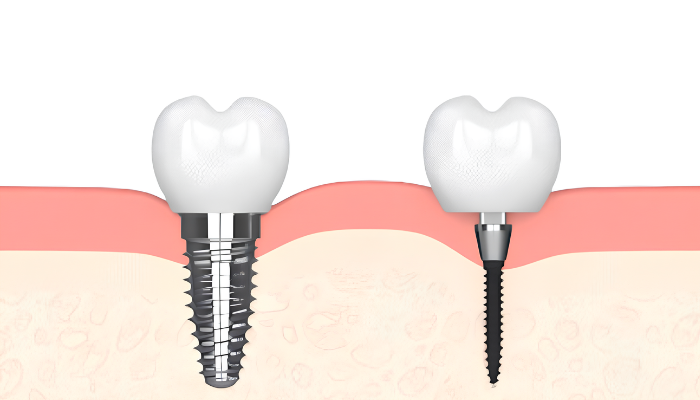
When you begin exploring dental implants, you may notice that there are more than one type. Traditional implants are widely known, but another option follows the same basic concept while using a different structure. Mini dental implants function much like their traditional counterparts. They are small titanium posts that we place into the jawbone to support a crown, bridge, or denture. The implant sits within the bone and provides the foundation that holds the restoration securely in place. If someone were to ask, “What are mini dental implants?” the simplest answer starts with two defining features: size and design.
Mini dental implants measure just under 3 millimeters in diameter and are also known as one-piece implants. In this design, the implant body, which sits in the bone, and the post that extends through the gum to hold the restoration are manufactured as a single, solid unit rather than separate components connected.
These two structural differences create important advantages for many patients.
What Is the Mini Dental Implant Process?
The placement process for a mini dental implant is much simpler than placing traditional implants. Because the implant is narrow and manufactured as a single unit, Dr. Jaime can often use a minimally invasive technique that disrupts the surrounding tissue as little as possible. In many cases, she places the implant through a very small opening in the gum or without creating a traditional incision.
After making a small pilot hole in the bone, Dr. Jaime guides the implant into position and secures it. The placement process typically takes about 10 to 15 minutes.
A traditional dental implant procedure often involves a different surgical approach. Because the implant is wider and made of multiple components, a large opening in the gum is created with a surgical flap to directly access the bone. The process requires more drilling and often occurs in multiple stages, with healing periods between them.
Larger flaps and sutures can lead to more post-operative soreness, visible swelling, and a longer early healing phase, particularly when bone grafting is involved. This approach is more suitable if the dentist needs direct access to reshape bone and add grafting material.
What Are the Benefits of Mini Dental Implants?
Mini dental implants offer several practical advantages because of their smaller size and minimally invasive placement. Creating a small opening in the bone allows us to place a narrow implant with minimal disruption to the surrounding tissue. That approach usually leads to less post-operative soreness, reduced swelling, and a shorter early healing period.
A minimally invasive approach can also expand who qualifies for treatment. Older adults or patients with medical conditions sometimes hesitate at the thought of implant surgery. Mini dental implants often remove many of those barriers. Treatment is quicker, gentler, and frequently completed in a single visit.
Bone availability becomes less restrictive in many cases as well. The narrow diameter of mini dental implants allows us to place them in areas where bone has become thin over time. Long-term denture wearers often hear that they do not have enough bone for traditional implants. Mini dental implants can often gain stability in those narrower ridges. As a result, many patients avoid bone grafting and the extended healing periods that follow.
You can see these advantages clearly with denture stabilization. After placement, we can often connect the denture to the implants the same day, providing immediate stability. That efficiency reduces the number of visits and limits multiple rounds of anesthesia, which can be especially helpful for patients who fatigue easily or have difficulty traveling to appointments.
Schedule Your Free Consultation With Dr. Jaime
Mini dental implants show that replacing teeth does not always require a large, complex surgical approach. A smaller implant and a minimally invasive technique can make treatment possible for many people who once believed implants were not an option.
Time rarely improves the conditions for tooth replacement. Bone continues to change, and unstable dentures or missing teeth rarely become easier to manage on their own. Exploring your options earlier often preserves more possibilities.
If mini dental implants sound like a solution worth considering, schedule a free consultation with Dr. Jaime.