

Complete dentures have helped many people rebuild their smile after complete tooth loss. In many cases, these restorations are carefully designed, properly fitted, and function exactly as intended. Even so, satisfaction is not always guaranteed. A denture may appear ideal when first fitted, yet the real test happens during day-to-day use. Studies have shown that a significant percentage of denture wearers report dissatisfaction, even when their restorations are considered acceptable by professional standards. In fact, findings indicate that roughly 10% of patients remained dissatisfied despite well-constructed dentures. It is this gap between expectation and experience that leads many individuals to explore alternatives such as Fix-on-Six.
Technical quality matters, but so does the wearer’s experience. Small variations in stability, bite force, and adaptation can significantly influence how a denture feels and functions over time. For individuals seeking a restoration that feels more secure and more closely integrated with the jaw, Fix-on-Six offers a fundamentally different approach to full-arch tooth replacement.
What Is Fix-on-Six?
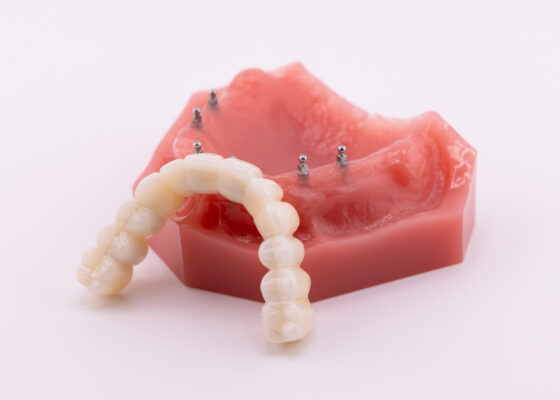
Fix-on-Six is a full-arch tooth replacement supported by mini dental implants. The name reflects two defining features of the restoration
The Fixed Connection
“Fix” describes how the restoration sits in the mouth. Unlike a removable denture, a fixed restoration stays in place. You do not take it out at night or for cleaning. The teeth remain anchored.
The restoration used in this approach is called a roundhouse bridge. It appears as a solid, one-piece, U-shaped arch of teeth that follows the natural curve of the jaw. From the front, it looks like a complete, natural smile. From above or below, the horseshoe shape becomes visible, reflecting the contour of the gums.
Without a full palate or bulky flanges, the bridge feels slimmer than a traditional denture. Many patients find that speech feels more natural and that the absence of a large acrylic plate improves overall comfort.
Stability comes from how the bridge is supported. Dr. Jaime places dental implants into the jawbone and secures the roundhouse bridge to them, creating a restoration that remains consistently in place.
The Implant Foundation
“Six” refers to the number of mini dental implants supporting the bridge. While six implants are common, support ranges from six to ten implants.
After placement, the implants integrate with the surrounding bone through osseointegration. Once integrated, the implants function similarly to natural tooth roots. They occupy the space where roots once were and direct chewing forces into the bone rather than the gums. That support is what provides the bridge with its strength and stability.
Fix-on-Six vs. All-on-6: How Are They Different?
The comparison can feel confusing at first glance. The names sound nearly identical, and both describe fixed, full-arch tooth replacement. Despite the similarity in wording, the treatments are based on different implant strategies.
All-on-4 and All-on-6 function as umbrella terms. They describe restorations where all the teeth in one jaw are supported by four, six, or more conventional dental implants. The numbers simply indicate how many standard-diameter implants anchor the bridge.
All-on-4 established the original framework. Two implants are typically positioned toward the front of the jaw, while two are placed farther back to maximize support. All-on-6 follows the same principle but increases the number of implants, adding reinforcement. Fix-on-Six, while similar in name, is supported by mini dental implants.
Understanding Mini Dental Implants
At Sunshine Dental, mini dental implants are the foundation of our full-arch restorations. Mini implants measure less than 3 millimeters in diameter, making them significantly narrower than traditional implants. Their reduced size influences everything from placement technique to healing time.
Mini dental implants require only a small pilot opening in the bone. Their narrow diameter means Dr. Jaime can place them using a minimally invasive technique. Minimally invasive placement generally involves less cutting and reduced disruption to surrounding tissue, frequently resulting in less postoperative soreness. Many patients find the recovery period noticeably easier to manage.
The conservative size of mini implants can also influence treatment planning. In some cases, their placement reduces the need for bone grafting or secondary uncovering procedures.
Traditional dental implants follow a different surgical approach. Standard implants require a larger opening in the bone, and depending on bone volume, grafting procedures may be recommended. Healing periods typically last 4 to 6 months before the final restoration is attached.
Discover a More Secure Denture Option With Fix-on-Six
A denture that shifts, feels loose, or never quite feels secure can make everyday life frustrating. Fix-on-Six replaces a removable denture with a fixed, full-arch restoration supported by mini dental implants.
Teeth should feel stable, secure, and reliable throughout the day. If comfort, function, or security has become a concern, Fix-on-Six may be worth considering. Mini dental implants provide a more dependable foundation for patients seeking greater stability. Contact us today to book a free consultation and discover a stronger alternative.