
Last Updated on January 19, 2026 by Dr. Lilian Jaime
If you suffer from dental disease, malnutrition, or genetic disorders, you may need your teeth extracted by a professional. Losing your permanent teeth may seem devastating, but dentures provide a second chance at a wonderful smile!
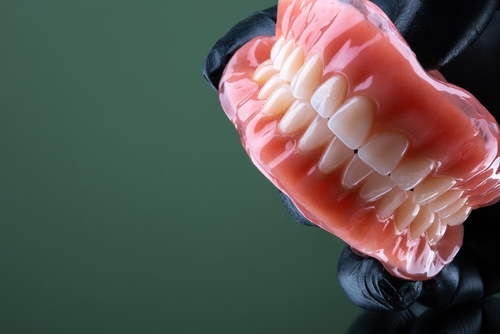 Your facial structure and speech will improve once you are suited with complete dentures, and chewing food will become easy once again. Immediate dentures give you a full set of pseudo-teeth while you wait for your gums to heal and your bone to realign. No matter which option you choose, we’ll ensure your replacement teeth are natural-looking and match your facial structure.
You may not need a full set of dentures. Partial dentures can replace any number of missing teeth and fasten to your remaining teeth with clasps. Dentures have come a long way, as today’s dentures are natural-looking and comfortable. We offer many other solutions for your dental problems, including partial dentures and mini dental implants.
We will customize your dentures to fit your unique bone structure and facial shape, so that they look and feel great! Once a full set of teeth is removed, the process of gum healing and bone realignment can take up to 6 months. Having a full set of immediate dentures during this time would be an excellent option.
Full Denture
An immediate complete denture is inserted immediately after the remaining teeth are removed. The dentist takes measurements and makes models of the patient’s jaw during a preliminary visit. With immediate dentures, the denture wearer does not have to be without teeth during the healing period. Even if you wear full dentures, you still must take good care of your mouth. Brush your gums, tongue, and palate every morning with a soft-bristled brush before you insert your dentures to stimulate circulation and help remove plaque.
And even if you wear full dentures, it’s important to visit your dentist regularly to maintain your overall oral health and get early warning of serious issues such as oral cancer.
Your dentures were made to fit you precisely and, if they are cared for properly, they do not change shape. But you may sometimes find they become loose due to natural changes in the gums and the bone supporting them. As the jawbone begins to shrink, so do the gums.
If you find your dentures no longer fit properly, see your dentist as soon as possible so adjustments can be made. Trying to change the fit of your dentures yourself can damage them and make them unrepairable so this would be a costly experiment!
Ill-fitting dentures repaired at home can also irritate the gums, tongue, and cheeks.
In an emergency, you could use denture adhesives to keep the dentures stable until you can see the dentist.
Partials
Partial dentures are used when some natural teeth still remain. Partial dentures can be very stable, especially when supported by natural teeth on either side. And because they are removable, it’s easy to keep clean.
A removable partial denture or bridge usually consists of replacement teeth attached to a gum-colored plastic base, which is connected by a metal framework to hold the denture in place in the mouth. Partial dentures are used when one or more natural teeth remain in the upper or lower jaw. A fixed bridge replaces one or more teeth by placing crowns on the teeth on either side of the space and attaching artificial teeth to them. This “bridge” is then cemented into place.
Missing teeth can also speed up bone loss and put the health of your gums and remaining teeth at risk. To prevent these issues, it is important to replace missing teeth promptly.
Partial dentures are an excellent, cost-effective solution for replacing multiple missing teeth. At your initial consultation, your dentist will let you know whether partial dentures can be an effective tooth replacement option for you.
Overdentures
People with missing teeth, including all or most of their teeth, typically have complete or partial dentures; this treatment option is called Overdentures.
Overdentures are replacement teeth retained by dental implants. Overdentures were developed to help both partial- and fully edentulous patients regain a quality of life that may have been missing since they lost their teeth.
Overdentures offer a variety of advantages as compared to conventional dentures. While some of these advantages are purely cosmetic, all of these can affect your quality of life, making you happier and healthier.
An implant-retained overdenture can help stop the deterioration of your natural facial contours. Keeping this bone alive and stimulated is the only way to halt the resorption that naturally occurs in areas where your natural teeth have been lost.
Denture Reline
New dentures will typically fit your mouth securely because they are designed specifically for your gums. However, as time goes on, your gum tissues will change, and the fit of the denture will become looser and more prone to movement inside your mouth. Having the denture professionally relined will help keep everything both secure and functional.
Soft Reline
Some patients are unable to wear conventional dentures due to tender gums or sore spots. You may recommend relining the denture with a material that remains pliable for 1 to 2 years before needing replacement. Such a material is much less likely to cause sore spots in the patient than standard hard reline acrylic. Patients experiencing these problems may also consider a more permanent solution of implant-retained dentures.
Temporary Relines
If dentures haven’t been serviced in a long time, a patient’s gums may be red, swollen, or misshapen. This creates problems when taking impressions for a new hard or soft reline and may lead to a denture that extends or exacerbates the problem.
A temporary, medicated reline material may be recommended to allow the inflammation to subside. This reline makes the denture fit much more tightly, and is usually soft and pliable. After a few weeks, the gums return to a more normal state. The patient is then ready for their new denture.