
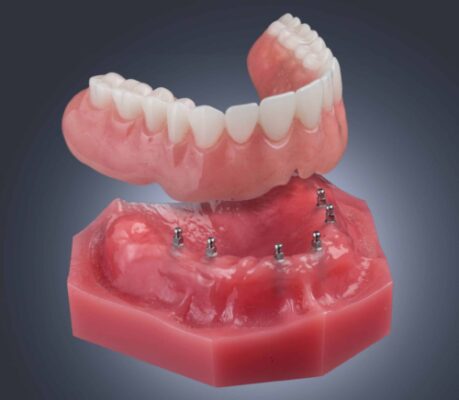
You do not need to know dental terminology to recognize floating dentures. The phrase explains itself. If your dentures lift when you talk, slide when you chew, or feel like they never quite settle into place, you already understand the problem. Many people experience this and assume it is just part of wearing dentures, even though it often signals a change in how the denture fits and functions. “Floating dentures” refers to traditional dentures that no longer stay securely seated on the gums. These dentures rest passively on soft tissue, without roots, clips, or anchors holding them in place. The denture can lift, rock, or drift during everyday movements like speaking, swallowing, or eating. Instead of feeling firmly seated, the appliance appears unstable and unpredictable, which is where the term “floating” originates.
At Sunshine Dental, we use dental implants to help dentures sit more securely, so they feel steadier when you speak, eat, and move through your day.
Why Do I Have Floating Dentures?
When dentures are first made, they fit closely because they are built around a particular moment in time. We take detailed impressions or digital scans of your gums and jaw, then record how your upper and lower teeth meet so chewing and speaking feel natural. That fit is initially secure, which is why many people are surprised when dentures begin to move months or years later. The shift occurs gradually as the mouth continues to change beneath a denture that remains unchanged.
The main driver of that change is loss of stimulation in the jawbone. The part of the jaw that once held your teeth exists primarily to support tooth roots. Every time you bite or chew, those roots send tiny mechanical signals into the bone. Once a tooth is gone, that signal stops. In response, the body begins to break down bone it no longer thinks it needs, a process known as bone resorption. Bone biology follows a basic rule. Without regular mechanical stress, bone gradually thins and shrinks. As the jawbone slowly changes shape, the gums above it change as well.
A denture base, usually made from rigid acrylic, cannot adapt to those changes. It is a static snapshot of how your mouth looked when the denture was made. As bone resorption continues, small gaps form between the denture and the gums. Air and saliva enter those spaces, and the denture starts to feel loose or buoyant, especially when you talk or eat. That is the “floating” sensation many people describe. Relines and rebases work by adding material to the inside of the denture to fill in the space and restore contact with the gums. But this solution only works for so long.
Dental Implants: A More Stable Solution for Floating Dentures
Mini dental implants help correct floating dentures by replacing the physical support once provided by natural tooth roots. Dr. Jaime places small titanium posts into the jawbone in the same locations where tooth roots used to be. This placement allows the implant to perform the function that the natural root once performed, rather than simply supporting a denture from above.
After placement, the surrounding bone undergoes a process known as osseointegration. During this phase, the bone grows tightly around the implant and bonds with it. The body recognizes the titanium post as stable and compatible, and over time, the implant becomes anchored within the jaw. As chewing forces pass through the implant, the bone continues to receive the mechanical stimulation it needs, which helps limit the bone loss that leads to denture movement.
Once the implant is secure, Dr. Jaime attaches the denture to it. At that point, the denture no longer relies solely on the gums for support. The implant and denture work together as a single system, creating a firm connection that resists lifting, shifting, and floating. Instead of resting on a changing foundation, the denture is anchored to the jaw, providing greater stability and control.
Explore a More Secure Denture Option
If your dentures no longer feel steady, that change is rarely random. In many cases, it reflects gradual changes in the jaw rather than an issue with how the denture was originally made.
At Sunshine Dental, we take the time to evaluate why dentures have lost stability and discuss options that address the underlying cause, rather than resorting to short-term adjustments. If you want to explore a more secure way to wear dentures, contact us today to book a free consultation.